Fluorite: A New High-Performance Game Engine Built on Dart and Flutter by Toyota
February 10, 2026
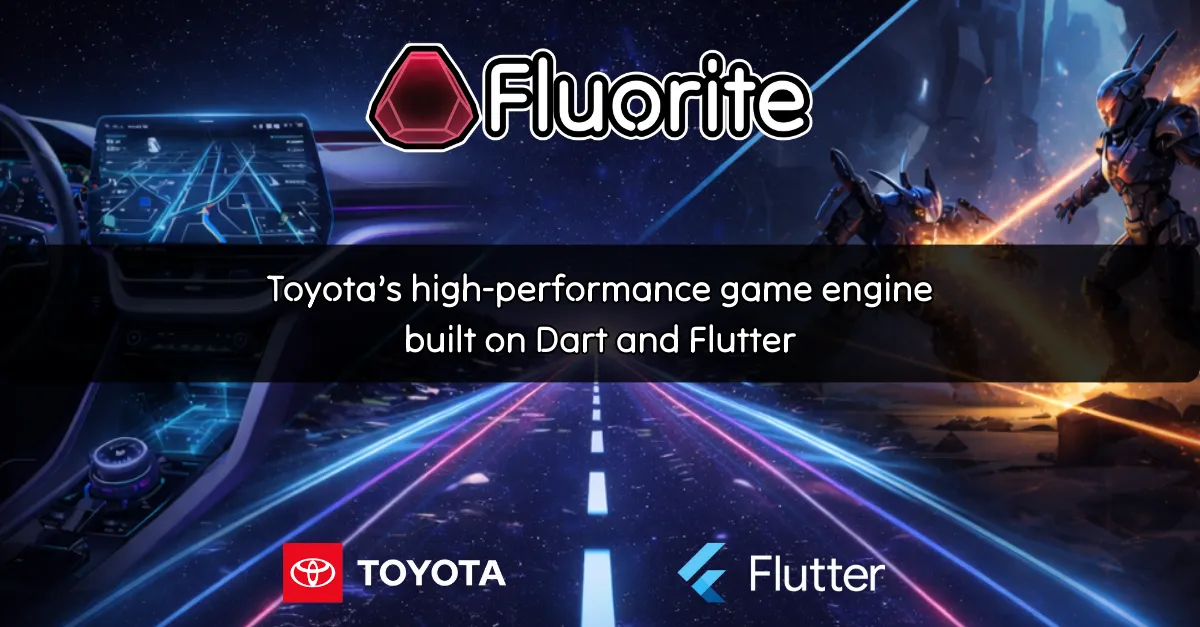
At FOSDEM 2026, Toyota Connected North America unveiled Fluorite, a console-grade game engine built on Dart and Flutter. Developed in collaboration with Very Good Ventures and the Automotive Grade Linux project, the engine is designed to bridge the gap between constrained embedded automotive systems and high-performance gaming.
Introduction: When Automotive Meets Console-Grade Gaming
When you list the titans of the game engine industry, names like Epic Games (Unreal) and Unity dominate the conversation. You certainly wouldn’t expect one of the world’s largest automakers to enter the chat.
Yet, that is exactly what happened.
Toyota Connected North America, in partnership with Very Good Ventures and the Automotive Grade Linux (AGL) project, has officially unveiled Fluorite—a brand-new, console-grade game engine announced at FOSDEM 2026. This isn’t just a marketing gimmick for a car configurator; Fluorite is a sophisticated, general-purpose engine designed to bring console-quality 3D rendering to embedded automotive systems while remaining viable for broader gaming applications.
The most surprising part? Fluorite is bringing the Dart programming language and the Flutter ecosystem into the high-stakes world of 3D game development.
The “Why”: Solving the Embedded Performance Puzzle
The modern automobile is essentially a high-performance computer on wheels. Dashboards now demand complex 3D navigation and visualizations at a rock-solid 60 frames per second. Toyota’s in-vehicle home screen already uses an embedded Flutter runtime on Yocto Linux with Wayland, deployed in production vehicles like the Toyota RAV4 2026.
However, traditional game engines fell short for automotive applications:
- Unity and Unreal Engine: Rejected due to proprietary blobs, high licensing fees, and excessive resource weight for embedded systems
- Godot: Found to have long startup times and was too resource-heavy for constrained automotive hardware
- Other Options: Deemed unstable or lacking stable APIs necessary for production automotive systems
Toyota needed an engine that was lean, modern, and capable of “zero-latency” integration between the 3D world and the 2D UI. When existing solutions didn’t fit, they built their own.
The Technical Core: Why Dart and Flutter?
Toyota has made a massive bet on the Google ecosystem for Fluorite, utilizing a hybrid architecture that balances developer velocity with raw execution speed. The engine leverages several proven technologies:
- Google’s Filament: A physically-based 3D rendering engine providing console-grade graphics
- SDL (Simple DirectMedia Layer): For cross-platform windowing and input handling
- Jolt Physics: Planned integration for physics simulation
- Flutter SDK: For seamless UI integration and developer tooling
1. The Hybrid Engine Structure
At its core, Fluorite uses a high-performance C++ Entity Component System (ECS) to handle raw data processing and memory management. However, the scripting layer—where developers write the actual game logic—is entirely Dart.
2. The Performance Gains of Dart AOT
Many developers associate Dart solely with mobile apps, but Fluorite leverages Dart’s ability to compile Ahead-of-Time (AOT) into native machine code (ARM, x64).
- Predictable Execution: Native compilation ensures smooth frame rates without the “jitter” often associated with interpreted languages.
- Lower Overhead: By removing the heavy resource weight of traditional proprietary engines, Fluorite delivers console-grade rendering on smaller footprints.
- Hot Reload: Developers gain access to Flutter’s “hot reload,” allowing for instant updates to game logic without recompiling the entire engine.
3. Seamless UI with Flutter
In many engines, the 3D world and the 2D UI struggle to communicate. Because Fluorite shares the same technology stack as Flutter, integrating complex UIs over 3D environments is seamless and high-performing.
Beyond the Dashboard
While born from automotive necessities, Toyota has positioned Fluorite as a general-purpose engine. By leveraging the widely-used Flutter ecosystem, it offers a viable alternative for indie developers and studios looking for a performant, modern workflow.
Current Status and Future Development
Fluorite is still in early development and not yet publicly available. The team is actively seeking collaborations with engineering teams to commit development resources to the project and establish a common roadmap for the engine. While the official website showcases the engine’s capabilities, no source code repository has been made public yet.
The project represents a collaborative effort between:
- Toyota Connected North America: Toyota Motor Corporation’s subsidiary focused on in-vehicle software and AI
- Very Good Ventures: Lead engineering partner on the Fluorite project
- Automotive Grade Linux (AGL): Open-source automotive software platform
Conclusion
Fluorite is significant validation for Dart and Flutter as high-performance technologies. Toyota has proven that you don’t need to sacrifice developer experience to achieve the raw speed required by next-generation hardware. Whether it’s powering a future EV or the next indie hit, Fluorite is ready to drive.
Explore the project: https://fluorite.game/
Resources
- FOSDEM 2026 Presentation: Fluorite Game Engine + Flutter
- Coverage: Phoronix | The Verge